
Everyone Agrees With Sophie Cunningham. They're Just Afraid to Say So.
A WNBA veteran said she wants to protect girls' basketball — and got treated like a villain for stating what most people already believe. Sophie Cunningham has never been the type to hold her tongue. The Indiana Fever guard built a national reputation in 2025 as Caitlin Clark's

A WNBA veteran said she wants to protect girls' basketball — and got treated like a villain for stating what most people already believe.
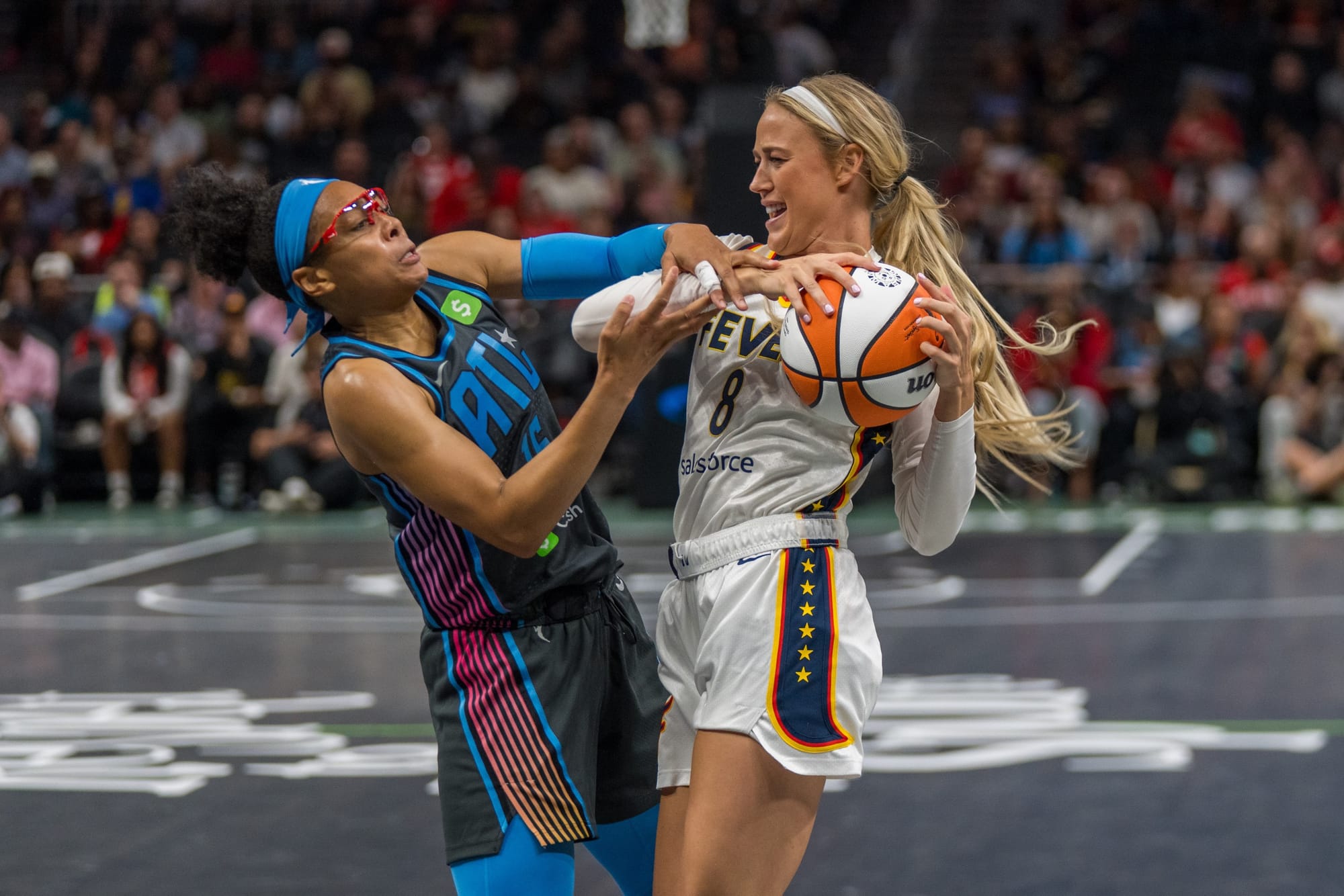
Sophie Cunningham has never been the type to hold her tongue. The Indiana Fever guard built a national reputation in 2025 as Caitlin Clark's on-court "enforcer" — the teammate who steps in when things get physical, the one who got ejected for yanking an opponent to the floor after a cheap shot at Clark. So it wasn't out of character when she said out loud that she wants to stand up for the little girls who dream of playing women's basketball, and that she doesn't believe biological males belong in the women's game.
The reaction was instant, and it was ugly. Not a debate — a branding. Bigot. Transphobe. MAGA. The usual kit, deployed to end the conversation before it could start.
Here's the uncomfortable part almost nobody will say plainly: a huge share of the people piling on quietly agree with her. They just can't admit it, because saying so out loud feels like defecting to a political tribe they've spent years defining themselves against. Poll after poll in recent years has found that a clear majority of Americans — including a striking number of Democrats, when the question is framed around fairness rather than identity — don't think athletes who went through male puberty should compete in women's categories. That's not a fringe view. It's the mainstream one. It has simply been driven underground, because a certain former president says it too, and for a lot of decent people the fear of sounding like him outweighs the courage to say what they actually think.
But fairness in sports was never a partisan question. It's a physical one. And the receipts are brutal.
The gap is real, and no amount of goodwill closes it
Male puberty is not a costume you can take off. It builds a fundamentally different machine: greater muscle mass, denser and heavier bone, larger hearts and lungs, longer levers, more fast-twitch power. In strength and power events the average gap between elite men and elite women runs from roughly 10 percent to well over 30 percent — a canyon, at the level where hundredths of a second and single points decide careers. And the sports-science literature is blunt on the follow-up question everyone wants to dodge: even after years of testosterone suppression, much of that advantage in strength, size, and bone structure remains. Hormone therapy narrows the gap. It does not erase it. There is no undo button on a body that grew up male — a point made not by a politician, but by former UFC champion Ronda Rousey: "if you go through puberty as a man, it's not something you can reverse."
If that sounds abstract, the record makes it concrete.
Exhibit A — Serena and Venus, humbled by a journeyman
In 1998, after the Williams sisters suggested they could beat any man ranked outside the world's top 200, a German player named Karsten Braasch — ranked around No. 203, a guy best known on tour for smoking cigarettes during changeovers — took them up on it in Australia. By multiple accounts he played a round of golf and had a couple of drinks beforehand, treating it as a lark. Then he beat Serena 6–1 and Venus 6–2, back to back. Two of the greatest athletes women's sport has ever produced, dismantled by a man who was, by his own tour's standards, a nobody. Not a champion. A middle-aged, mid-pack pro on a casual afternoon.
Exhibit B — the teenagers who beat the world champions
In 2017, the reigning World Cup–winning U.S. Women's National Team — arguably the most dominant program in the history of women's soccer — played a scrimmage against the FC Dallas under-15 boys academy squad. Not professionals. Not even high schoolers out of the youth ranks. Fifteen-year-old boys. The boys won 5–2. The best women on the planet, beaten by children who couldn't yet drive.
Exhibit C — from the men's mid-pack to a women's national title
Lia Thomas swam three seasons on the University of Pennsylvania men's team, ranking in the national mid-hundreds. After transitioning and following the NCAA's testosterone-suppression protocol, Thomas became, in 2022, the first openly transgender athlete to win an NCAA Division I national championship, taking the women's 500-yard freestyle. Thomas was later barred from elite women's competition by World Aquatics. Set aside every argument about identity and just look at the trajectory: unremarkable among men, national champion among women. The category change was the difference.
Exhibit D — when the advantage turns dangerous
In combat sports the stakes stop being medals and start being skulls. In 2014, trans MMA fighter Fallon Fox fought Tamikka Brents — and in the first round Brents suffered a concussion, a fractured orbital bone, and needed seven staples in her head. Brents, no shrinking violet, said it plainly afterward: "I've fought a lot of women and have never felt the strength that I felt in a fight as I did that night… I've never felt so overpowered ever in my life, and I am an abnormally strong female in my own right." This is the part the euphemisms can't cover. In a collision sport, a physical mismatch isn't unfair — it's a safety hazard.
The real fear isn't being wrong. It's being associated.
Put those four cases beside each other and the pattern is undeniable — and notice it has nothing to do with effort, skill, or heart. The women in every one of these stories had those in abundance. The variable was biology, full stop.
So why does saying this get a WNBA player branded a bigot? Because we have let the fairness question get swallowed by the identity culture war, and now people are terrified that agreeing with an obvious physical truth will file them on the wrong team. That's the tell. When someone privately nods along and then publicly attacks the person who said it, they're not defending a principle — they're managing their reputation. Cunningham is not a political operative. She's a professional athlete in one of the most progressive leagues in American sports, speaking up for the girls coming after her. If she can be cast out for it, the message to every parent and coach and young female athlete is clear: keep your mouth shut.
And to the critics already reaching for the word "transphobe": none of this requires an ounce of cruelty toward transgender people, who deserve dignity, respect, and a real place to compete — an open or separate category is a solvable design problem, not a moral outrage. Inclusion matters. But inclusion cannot mean quietly deleting the very thing the women's category was created to protect: a level field for people who did not have the physical head start of male puberty. Those are two different questions, and Cunningham was only ever pointing at one of them.
That's the whole thing. Not left versus right. Fairness versus pretending. Sophie Cunningham didn't say anything most Americans don't already believe. She just had the nerve to say it with her name attached — and the backlash she's taking is the price of a consensus that everyone feels and too few will admit.


